a 'steampunk' history of 19th century Jamaica
  • before
    • - pages started
    • blog
    • links
  • at sea
    • - paddle-wheel steamers
    • - screw-propeller steamers
  • on land
    • - mining >
      • - copper
    • - iron structures >
      • - the iron bridge >
        • 1799 act
      • - the Naval Hospital
      • - the Morant Point Lighthouse
      • - the iron church
    • - the railway
    • - on the roads >
      • - traction engines
      • - bicycles
      • - steam rollers
      • - horseless carriages >
        • - on the motor car
      • - street cars
  • 'up in the air'
    • - ballooning and beyond
    • - telecommunications >
      • - telegraph >
        • Admiral's Pen
        • - early electric telegraph
        • - international telegraph
        • - island-wide telegraph
      • - telephone >
        • - acoustic telephones
        • - the Jamaica Telephone Company I >
          • who was C Lambdin?
          • - Hodge's 'Kiosk'
        • - the Jamaica Telephone Company II >
          • - some of the investors
  • light and power
    • - the old >
      • - candles
      • - water
      • - wind
    • - the new >
      • - kerosene
      • - gas
      • - electricity
  • entertainment
    • - merry-go-rounds
    • - image technology >
      • - magic lanterns
      • - panoramas >
        • - the 'Panorama'
        • - panopticons
      • - transparencies
      • - photography >
        • F. A. Freeman
        • O. & E. Bavastro
        • J. B Valdés
      • - kinetoscope
    • - sound technology >
      • - melodeons & such
      • - 'music boxes'
      • - Edison phonograph 1878
      • boobies eggs
      • - the phonograph continued
    • - toys >
      • - Pharoah's Serpents
      • - games & puzzles
  • at home & work
    • - agriculture >
      • - Mountain Cabbage
      • - silk >
        • 'Mulberry Mania' USA >
          • Samuel Whitmarsh
        • and in Jamaica
      • - and cotton
      • - ramie
      • - pimento sticks
      • - bitterwood >
        • bibliography
    • - turtle industries
    • - clothing >
      • Edmiston & Son
    • - ice
    • - the Etna and other such devices >
      • - 'London Society', vol 14, 1868
    • - matches
    • - the sewing machine >
      • - 'London Society', vol 15, 1869
    • - typewriters & other office equipment >
      • Lithograms
      • 'Cyclopaedia of Useful Arts'
    • - food & drink >
      • - baking bread
      • - boobies eggs
      • - liquid refreshment >
        • Arctic Soda Water Apparatus
    • - soap
    • - tobacco indusry
    • - washing machines
    • research >
      • visiting researchers >
        • from Johns Hopkins >
          • New Brighton
          • 'Columbus Marine Biological Station'
      • medical research >
        • - vaccination >
          • a treatise on the cow-pox
          • - Minot Digest, Vaccination Laws


the phonograph continued

Picture


Picture
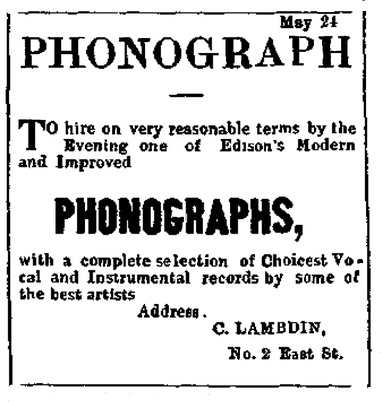
Daily Gleaner, 1893
Picture
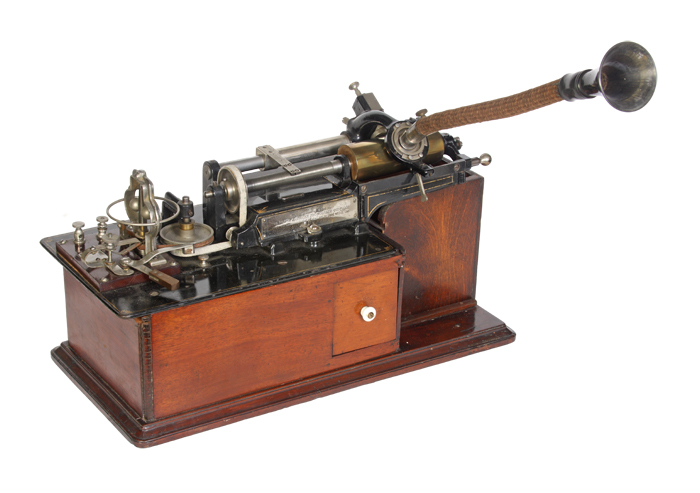
Edison Class M phonograph, ca 1893
Daily Gleaner, May 24, 1893
      Evenings with the Phonograph
   A novel idea has been hit upon and carried out by Mr. C Lambdin by which he places that wonderful modern invention the phonograph within the reach of private householders. It is well known how dull many social evenings are in the city and to create a new source of amusement as well as to interest young and old, Mr. Lambdin has obtained one of the latest forms of Edison's instrument and is renting it out by the evening, an assistant accompanying it to manipulate the records. The selections include all the popular songs, duets, quartettes, band
pieces, speeches, etc, in abundance, and are given on one evening The list is being constantly added to by importation. The instrument is one of the best we have heard, the tone being exceedingly clear and distinct. We can conceive of nothing calculated to pass an evening away more delightfully than the presence of this resourceful instrument We refer to advertisement for particulars.

. . . . listen to an Edison type recording from 1893, 'After the ball is over' sung by George Gaskin, 1893, the Commodore's Song sung by Edward M. Favor, 1893, and explore the world of early phonograph recordings at the -
Picture
Picture
Picture
Picture
jamaica.history 2017

facebook.com/Jamaica.history

jamaica(dot)history(at)outlook(dot)com

Proudly powered by Weebly